Two AV companies receive the same event brief.
One quotes £8,000.
Another quote is £11,500.
It is tempting to conclude that the first supplier is cheaper. But what if the £8,000 proposal covers equipment and setup only, while the other includes show technicians, rehearsal, transport, de-rig, backup systems and technical management?
You are no longer comparing £8,000 with £11,500.
You are comparing two different scopes.
That is the central rule when reviewing AV hire quotes in London: make the scope comparable before comparing the price.
AV proposals can be structured in very different ways. Equipment may be itemised individually, bundled into packages or included within a production fee. Crew may be charged separately. Setup and de-rig hours may be estimated differently. Venue charges, overtime and specialist services may sit outside the headline figure.
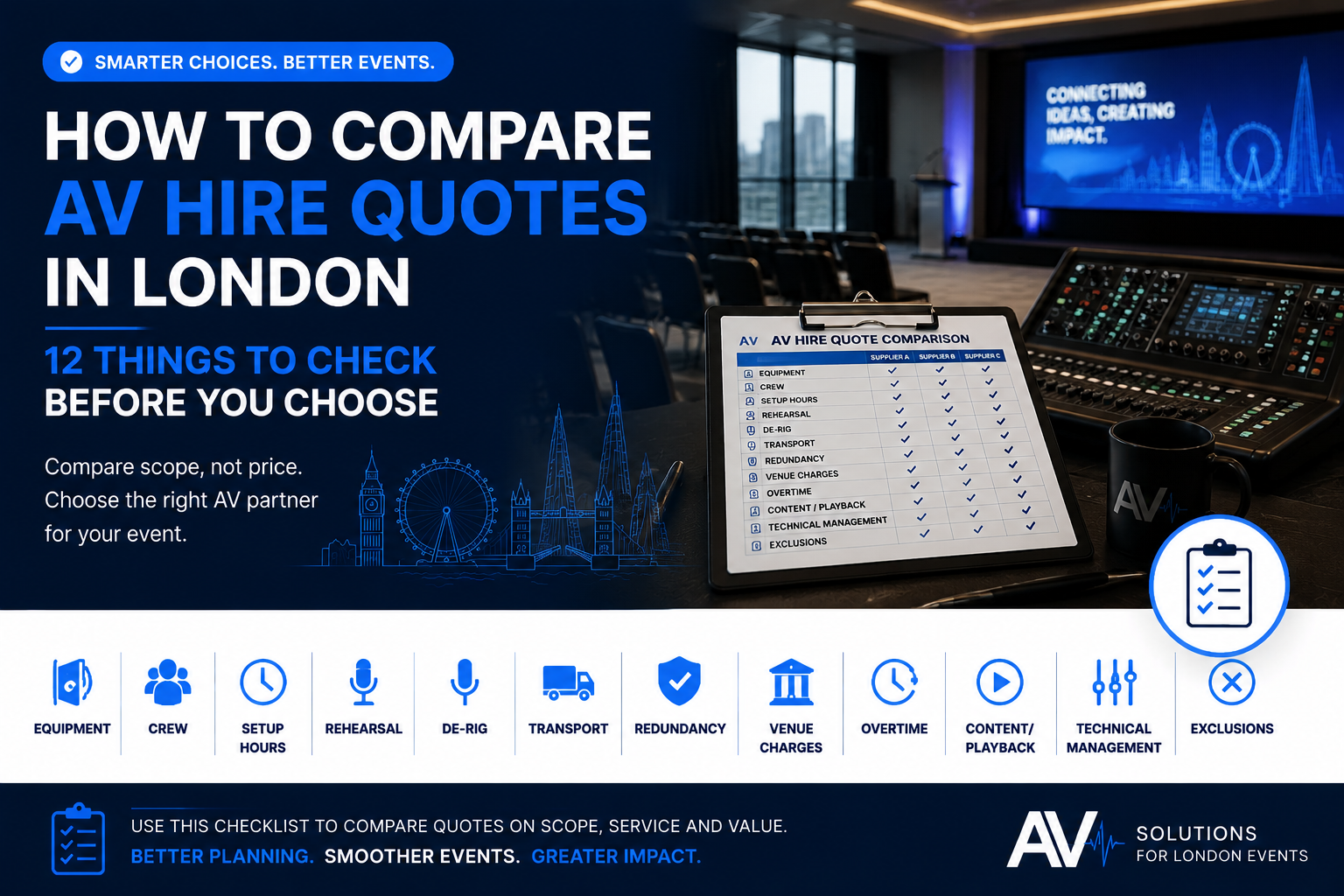
The following 12 checks will help you understand what you are actually buying before choosing an AV supplier.
Why can AV hire quotes for the same event be so different?
AV quotes can vary substantially because suppliers may make different assumptions about equipment, labour, event complexity, access, rehearsal, contingency and technical responsibility.
A quotation is not simply a price list. It is a priced interpretation of your event brief.
One supplier may assume:
- Four hours for setup
- One technician onsite
- No rehearsal
- Venue internet supplied separately
- Basic presentation playback
- Immediate access for de-rig
Another may allow:
- Eight hours for setup
- Dedicated audio, video and lighting operators
- A full technical rehearsal
- Backup playback
- Venue liaison
- Overnight de-rig
Both may describe their offer as “conference AV”.
The details underneath that description are what matter.
AVIXA’s guidance on AV needs assessment makes a similar underlying point: technical planning should start by understanding the actual requirements of the space, users and objectives rather than selecting technology for its own sake.
Start by putting every AV quote into the same comparison format
Before evaluating price, create one comparison sheet and transfer each supplier’s scope into the same categories.
Do not try to compare PDFs line by line. Different suppliers package services differently.
Use a structure such as this:
| Scope area | Supplier A | Supplier B | Supplier C |
| Equipment | Included | Included | Included |
| Setup crew | ? | Included | Included |
| Show crew | Extra | Included | Included |
| Rehearsal | Not stated | 3 hours | 2 hours |
| Transport | Included | Included | Extra |
| De-rig | Extra | Included | Included |
| Backup systems | Not stated | Included | Limited |
| Project management | Not stated | Included | Included |
| Venue charges | Excluded | Excluded | Excluded |
| Overtime | £? | £? | £? |
| Streaming | Not included | Optional | Included |
| Total | £X | £X | £X |
The question marks are important.
They show where you need clarification before making a decision.
Practitioner insight: the least detailed quote can look the cheapest.
A short quote is not automatically a bad quote.
But a low total becomes difficult to assess if you cannot see the assumptions behind it.
A quote that explicitly includes eight crew hours, rehearsal and de-rig may initially appear more expensive than one that simply says “technician included”.
Ask what “included” actually means.
The more precisely you can establish who, what, when and for how long, the easier the comparison becomes.
1. Are all quotes pricing the same event scope?
First, confirm that every supplier is responding to the same version of your event brief.
Check:
- Event date
- Venue
- Room or rooms
- Audience size
- Seating format
- Running order
- Speaker numbers
- Event timings
- Breakout spaces
- Recording requirements
- Streaming requirements
- Set up and de-rig windows
This sounds obvious, but event details change quickly.
You may have told Supplier A about the original four-person panel, while Supplier B received the revised version with seven panellists and audience Q&A.
The second proposal may therefore include more wireless microphones, more audio channels and additional crew time.
Compare the date or version of the brief used by each supplier.
If necessary, send the final brief to everyone and request a revised quote before making the commercial comparison.
2. Does the equipment specification achieve the same result?
Do not compare equipment by quantity alone. Check what each system is expected to achieve in the room.
Two proposals might both include the following:
- PA system
- Four microphones
- Two screens
- Projector
- Lighting
That does not mean the systems are equivalent.
For sound, consider:
- Coverage across the room
- Microphone type
- Number of simultaneous wireless channels
- Mixing requirements
- Playback inputs
- Panel and Q&A requirements
- Recording or streaming feeds
For video, compare:
- Display dimensions
- Projection versus LED
- Projector output
- Screen positions
- Confidence monitors
- Video switching
- Presentation playback
- Camera feeds
- Backup signal paths
The supplier should be able to explain why the specification suits the room and programme.
If you are still assessing the technical approach, reviewing the supplier’s available AV equipment hire options can also help you understand whether the proposal is equipment-only or part of a wider production setup.
Do not compare model numbers without context
A more expensive projector, loudspeaker or microphone is not automatically the better choice.
Likewise, the cheapest piece of equipment is not necessarily inadequate.
Ask:
Why has this equipment been specified for our venue and programme?
A useful answer should relate back to matters such as coverage, viewing distance, ambient light, content, room dimensions or programme complexity.
3. How many crew members are included, and what are their roles?
Crew structure can explain a large difference between two AV quotes, so compare responsibilities and headcount as well.
Depending on the event, roles may include:
- Lead technician
- Audio engineer
- Video technician
- Lighting operator
- Playback operator
- Camera operator
- Streaming technician
- Stage manager
- Show caller
- Production manager
- Riggers
A simple presentation may not need to represent each discipline separately.
A complex conference, awards show or hybrid event may.
Ask each supplier:
- How many people are included?
- What does each person do?
- When does each crew member arrive?
- Are they onsite for the full event?
- Who is responsible for live technical decisions?
Audio Visual Hire London’s verified conference AV hire service, for example, scales engineering support to the show rather than treating technician numbers as a fixed requirement.
That is the type of detail you need to clarify with every supplier.
Check also: Difference between AV hire and full event production
4. How many setup hours are actually included?
Setup time should be compared explicitly because a quote based on an unrealistic get-in window may become more expensive later.
Ask what time the crew plans to:
- Arrive
- Unload
- Build
- Rig
- Cable
- Power up
- Test
- Complete sound checks
- Test presentations
- Hand the room over
Then compare those assumptions against the venue’s confirmed access window.
London logistics can make this particularly important.
A supplier may need to work around:
- Loading-bay bookings
- Goods-lift access
- Security check-in
- Restricted parking
- Shared service corridors
- Venue turnaround schedules
- Limited overnight access
Do not assume that four quoted setup hours and eight quoted setup hours represent the same plan.
HSE’s venue guidance recommends considering site access, infrastructure and the needs of the workforce when assessing a venue.
5. Is technical rehearsal time included?
Rehearsal should appear clearly in the scope whenever the programme is complex enough to need it.
A rehearsal may include:
- Speaker microphone checks
- Presentation testing
- Video playback
- Walk-on cues
- Lighting cues
- Panel transitions
- Remote presenter checks
- Camera framing
- Streaming tests
- Awards stings
- Show calling
Do not confuse equipment testing with a technical rehearsal.
Equipment testing asks:
Does the system work?
A rehearsal asks:
Does the event work through this system?
Those are different questions.
Example
Imagine a 300-delegate conference with:
- CEO keynote
- Three videos
- Six-person panel
- Audience Q&A
- Remote speaker
- Closing presentation
Supplier A includes two hours of rehearsal.
Supplier B assumes presenters arrive 30 minutes before the doors.
Even with an identical equipment package, the two proposals do not carry the same operational risk.
6. Does the quote include de-rig and get-out?
Confirm whether equipment removal, crew and vehicle collection after the event are included in the quoted total.
De-rig is not simply “packing up”.
Depending on the production, it can involve:
- Power-down
- Equipment removal
- Cable recovery
- Screen dismantling
- Lighting de-rig
- Stage breakdown
- Rigging operations
- Flight-case loading
- Venue handover
- Vehicle loading
HSE notes that safety management remains important during breakdown and load-out, when higher-risk work may still be taking place despite fewer people being on site.
Ask whether the quote assumes:
- Immediate de-rig after the show
- Overnight working
- Next-morning collection
- A fixed venue clear time
A late-night London get-out can have very different labour and transport requirements from next-day access.
7. Are delivery and transport included?
Check whether transport covers the full logistics requirement rather than assuming “delivery” means everything.
Clarify:
- Delivery to venue
- Collection
- Number of vehicles
- Additional trips
- Parking
- Loading charges
- Congestion-related costs, where applicable
- Waiting time
- Overnight vehicle requirements
- Equipment transfer between multiple rooms or venues
A supplier with a lower equipment price may charge logistics separately.
Another may include the complete transport requirement.
HSE guidance on loading areas also highlights the importance of suitable space and safe movement around loading and unloading operations, reinforcing why venue logistics should be planned rather than treated as an incidental delivery task.
London-specific check: ask who has confirmed the load-in
For a central London venue, ask:
Has the loading arrangement been confirmed with the venue, or is the quote based on an assumption?
That question can uncover significant differences between proposals.
8. What backup and redundancy are included?
Compare what happens when something fails, not only what is required when everything works normally.
Relevant contingency measures may include:
- Spare microphones
- Backup presentation laptop
- Duplicate playback files
- Alternative signal path
- Spare cabling
- Backup streaming connection
- Additional power contingency
- Replacement equipment onsite or nearby
Not every item needs a duplicate.
Redundancy should be proportionate to the risk and importance of the event.
A small internal meeting and a live investor AGM do not require the same level of contingency planning.
For hybrid events, redundancy may be especially important because the technical system serves both the room and the remote audience. Audio Visual Hire London’s hybrid streaming service, for example, includes venue connectivity testing and failover checks as part of its documented process.
Ask other suppliers what equivalent contingency is included in their scope.
9. Which venue costs sit outside the AV quote?
Venue-related charges are often separate from the AV supplier’s price, so identify them before comparing your real event cost.
Possible venue-controlled costs can include:
- Rigging
- Power
- Internet
- Loading
- Parking
- Security
- Additional venue technicians
- Furniture removal
- Overnight access
- Storage
- Cleaning
- Room extensions
Do not assume these charges apply at every London venue.
Ask the venue and supplier to clarify responsibilities for your specific event.
This is especially important when an external AV company must connect to the venue’s infrastructure.
HSE guidance states that where responsibility for a venue is shared, respective responsibilities and liaison arrangements should be clearly defined.
10. What happens if the schedule runs into overtime?
Always establish overtime rules before choosing a supplier, particularly when access or event timings may change.
Ask:
- What hours does the quote cover?
- When does overtime begin?
- Is it calculated per technician?
- Is there a minimum overtime period?
- Does overtime apply during delayed load-in?
- What happens if the event finishes late?
- What happens if venue access is delayed?
- Are overnight hours priced differently?
- Are travel or accommodation affected?
This is not about assuming the event will overrun.
It is about understanding the commercial consequences if it does.
Common mistake: comparing planned totals but ignoring overtime exposure
Suppose:
Supplier A
- Lower initial crew cost
- Tight setup window
- Over time after the quoted call
Supplier B
- Higher initial crew cost
- More realistic setup allocation
- Rehearsal already included
Supplier A may still be the better choice.
But you cannot know that until you understand both the base price and the exposure to additional hours.
11. Is content and presentation management included?
Check who is responsible for receiving, testing, organising and playing the content during the event.
This can be easily overlooked because the quote may simply say “video playback”.
Clarify responsibility for:
- PowerPoint files
- Keynote files
- Videos
- Walk-in loops
- Sponsor graphics
- Holding slides
- Award stings
- Music
- Presenter notes
- Last-minute file changes
- Multiple laptops
- Remote presentation feeds
Ask whether content is tested before the event.
Also ask who operates playback live.
For a simple presentation, this may require relatively little support.
For a conference with dozens of speakers and frequent media cues, content management can become a significant part of the production role.
12. What is excluded, optional or still subject to confirmation?
The exclusions section can be more important than the equipment list because it shows where additional costs or responsibilities may still appear.
Look for phrases such as:
- Not included
- By client
- By venue
- Optional
- TBC
- Subject to survey
- Subject to availability
- Additional cost
- To be confirmed
- Third-party cost
Then turn every unclear item into a question.
For example:
“Venue internet excluded.”
Ask:
Who orders it, what specifications are required, and what happens if the venue charges separately?
Or:
“Rigging subject to venue approval.”
Ask:
Has rigging been included in the total, or will it be quoted after the site visit?
This does not mean exclusions are a problem.
A transparent exclusion is useful.
The problem is an assumption you discover after choosing the supplier.
Compare technical management, not just equipment and crew
For complex events, establish who owns coordination from the first planning meeting through to de-rig.
Technical management can include:
- Supplier coordination
- Venue liaison
- Site visits
- Technical drawings
- Crew calls
- Running-order review
- Speaker planning
- Risk assessments
- Method statements
- Show calling
- Technical rehearsals
- Post-event reporting
AVIXA project-management guidance specifically treats scope, assumptions, constraints, risk and change management as distinct parts of AV project planning.
That matters because two companies can supply similar equipment while taking very different levels of responsibility for the event.
For more complex corporate productions, compare an equipment-focused quote with the actual responsibilities included in a full event production service.
They are not necessarily the same purchase.
A practical AV quote comparison scorecard
Use a weighted scorecard once you have normalised the scopes. Price should remain important, but it should not hide gaps in delivery.
| Area | Questions to answer | Suggested importance |
| Scope match | Does it meet the same brief? | Essential |
| Equipment | Is the specification appropriate? | High |
| Crew | Are roles and hours clear? | High |
| Setup | Is the get-in realistic? | High |
| Rehearsal | Is sufficient time included? | High |
| De-rig | Is get-out fully covered? | Medium/High |
| Logistics | Are transport and access clear? | Medium/High |
| Redundancy | What happens if something fails? | High for critical events |
| Technical management | Who owns coordination? | High for complex events |
| Venue costs | What sits outside the quote? | High |
| Overtime | What could create extra labour costs? | Medium |
| Exclusions | What remains unpriced? | Essential |
| Total cost | What is the like-for-like total? | Essential |
Do not blindly assign a numerical score if one requirement is critical.
For example, a supplier that cannot support your required hybrid stream should not win simply because it scores well on price and logistics.
Use the scorecard to make differences visible, then apply judgement.
What should you ask an AV company before accepting a quote?
Before approving the proposal, ask the supplier to confirm the assumptions that could materially change the price or delivery.
A useful final check is:
- Is this based on the latest running order?
- What equipment is included?
- Which crew roles are included?
- What hours are included for setup?
- Is rehearsal included?
- Is the show operation included?
- Is de-rig included?
- Is transport included?
- What redundancy is planned?
- Which venue charges are excluded?
- When does overtime apply?
- What is still provisional or subject to survey?
If you cannot answer those questions from the quote itself, ask before signing.
Common mistake: asking suppliers to “match the cheapest quote”
Do not ask one supplier to match another supplier’s total until you know whether their scopes match.
If Supplier B is £2,000 more expensive because it includes:
- Additional engineer
- Full rehearsal
- Backup playback
- De-rig
- Transport
Asking it to “match Supplier A” may simply result in the removal of those items.
You have reduced the price by reducing the scope.
A better question is:
“Supplier A is lower. Can you explain which parts of your scope account for the difference?”
That gives the supplier an opportunity to identify genuine differences.
You can then decide whether those differences matter.
Which AV quote offers the best value?
The best-value AV quote is generally the proposal that meets the required technical scope, makes its assumptions clear and gives you an understandable total cost for the event you are actually planning.
That is not always the cheapest quote.
It is not always the most expensive either.
A higher quote may contain unnecessary equipment.
A lower quote may be perfectly appropriate for a simple event.
The purpose of comparison is not to justify spending more.
It is to establish:
What are we getting?
Who is responsible for it?
What is missing?
What could change the final cost?
Once those four questions are clear, price becomes much easier to evaluate.
FAQs
Should I always choose the cheapest AV hire quote?
No. First, check whether the cheapest proposal covers the same scope. It may exclude show technicians, rehearsals, transport, de-rigging, venue costs, or backup equipment. Equally, a higher quote may include elements your event does not require. Compare like-for-like scope first, then decide which proposal offers the most appropriate value.
Why are AV quotes from different companies so different?
Suppliers may specify different equipment, crew numbers, setup hours and levels of technical support. They may also make different assumptions about venue access, rehearsals, transport and contingency. Ask each supplier to confirm its scope and exclusions before assuming that the price difference represents a simple difference in margin.
Should an AV quote include technicians?
That depends on the service and complexity of the event. Dry equipment hire may not require onsite technicians, while conferences, awards, hybrid events and productions with multiple cues often need technical operators. Check exactly which crew roles are included, their working hours and whether they remain onsite during the live event.
What costs are often excluded from an AV quote?
Possible exclusions include venue internet, rigging, power, parking, security, overtime, accommodation, additional rehearsal, content creation and late scope changes. These are not universally excluded, so read the individual proposal carefully and ask who is responsible for each item.
How can I compare AV quotes when suppliers use different formats?
Create one comparison sheet with consistent categories for equipment, crew, setup, rehearsal, show operation, de-rig, transport, redundancy, project management, venue costs, overtime and exclusions. Transfer each quote into that structure. Any blank or unclear field becomes a question for the supplier.
What information should I give suppliers so their AV quotes are comparable?
Send each supplier the same event brief, including the venue, room, date, audience, floor plan, timings, running order, speakers, presentation content and any recording or streaming requirements. Using the same brief reduces the chance that suppliers price different versions of the event.
Conclusion
Comparing AV hire quotes in London is not about finding the smallest figure at the bottom of the page.
It is about finding out what sits above it.
Normalise the scope first. Check the equipment, crew, setup, rehearsal, de-rig, transport, contingency, venue costs, overtime, content management and exclusions.
Then compare the total.
That process may confirm that the lowest quote really is the best option. It may also reveal that another proposal costs more because it covers work that the cheaper quote leaves unpriced.
Either way, you are making the decision from the actual scope rather than the headline number.
If you already have an event date, venue and brief, you can send the requirements to Audio Visual Hire London for an itemised proposal and use the same comparison framework when reviewing your options.