AV hire and full event production overlap, but they are not the same service. AV hire gives you the sound systems, microphones, screens, lighting and other audiovisual equipment your event requires, with delivery, installation and technicians added where agreed. Full event production goes further by planning how AV, staging, lighting, content, crew and live cues work together, then managing that technical delivery through rehearsal and the live event.
At Audio Visual Hire London, we provide both. The choice usually comes down to complexity and responsibility rather than event size.
If you already have control of the running order and know what technical systems are required, AV hire may be enough. If you need one team to design, coordinate, and operate those systems as part of the wider event, full event production is likely the better fit.
What is the difference between AV hire and full event production?
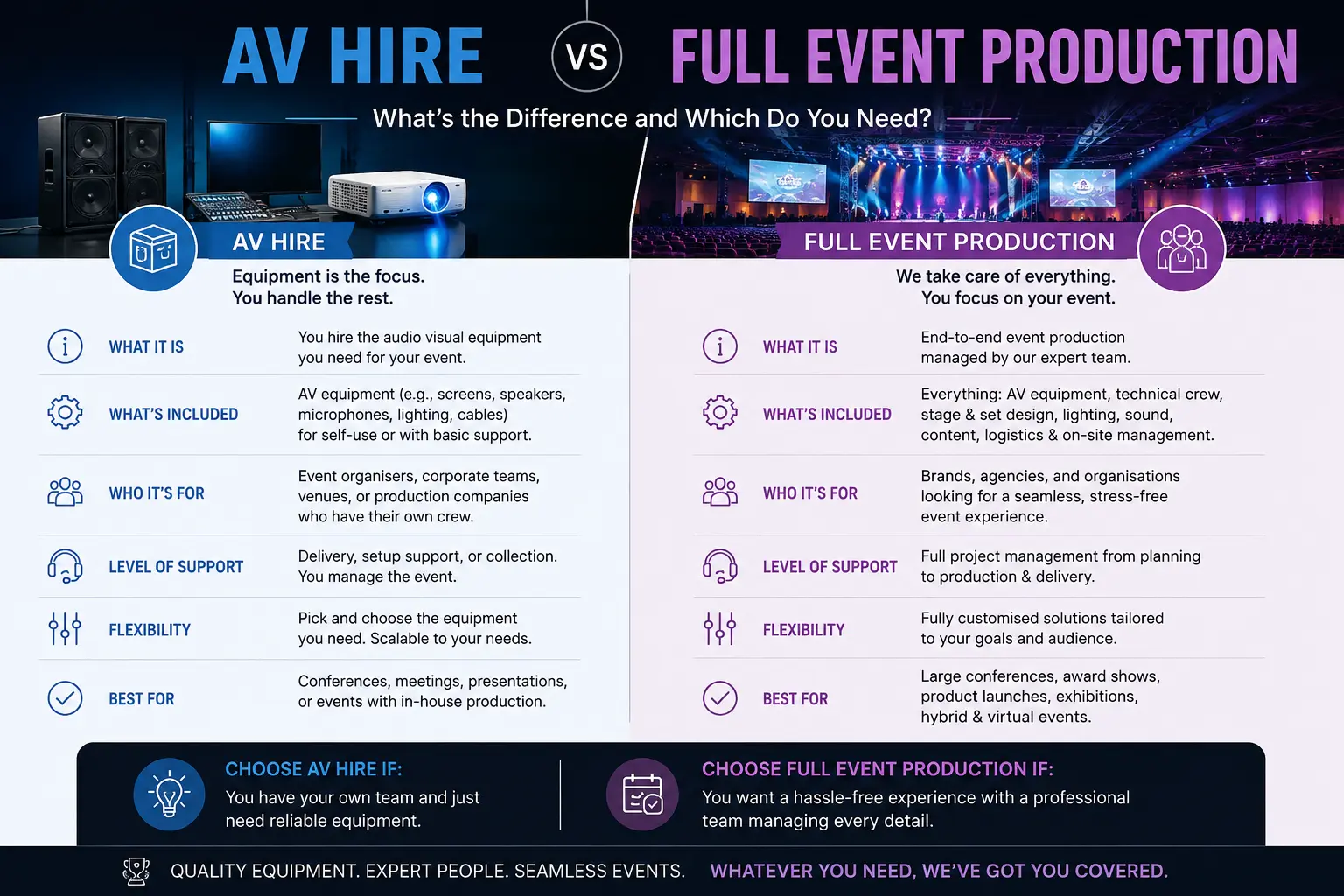
The main difference is the scope of responsibility. AV hire supplies the audiovisual systems your event needs within an agreed technical scope. Full event production designs, coordinates, and operates the technical event as one connected whole, from planning through to the live show.
| Area | AV hire | Full event production |
| Equipment | AV systems supplied | AV specified within the complete production |
| Technical design | Limited or agreed technical scope | Integrated production design |
| Staging and set | May be arranged separately | Coordinated with AV and show design |
| Crew | Technicians where agreed | Production manager plus specialist crew as required |
| Content | Usually supplied by the organiser | Formats, playback and live cues coordinated |
| Rehearsal | Scope-dependent | Planned where the event requires it |
| Live cues | May remain with the organiser | Managed within the running order |
| Venue liaison | Focused on agreed AV requirements | Wider technical requirements coordinated with the venue |
| Contingency | Based on the equipment and hire scope | Considered across the technical production |
Supplier scopes vary, so the quotation should always make clear exactly what is included.
Well, it is also important not to assume that AV hire means equipment-only rental. According to the AVIXA research, professional AV technicians are responsible for setting up, operating and maintaining audiovisual systems, which is why AV hire can include skilled technical support without becoming a full production-management service.
What does AV hire actually include?
AV hire covers the audiovisual equipment your event needs, with installation and technical operation included where agreed.
Depending on the brief, that can include:
- Microphones
- PA and sound systems
- Screens and projectors
- LED video walls
- Presentation equipment
- Lighting
- Cameras
- Streaming equipment
- Delivery and installation
- AV technicians
Dry hire means equipment supplied without operators. That can work well when an organiser, venue or production agency already has an experienced technical team.
Corporate AV hire can also include technicians who deliver, install and operate the systems booked for the event.
AV hire is often the right option for a straightforward meeting, seminar or presentation where the staging is already arranged, the content is final and only a small number of live cues are required.
The common thread is that someone on your side already owns the technical plan. Our audio visual hire service in London is designed for exactly this type of requirement.
What does a full-service event production company actually do?
A full-service event production company takes responsibility for how the technical and creative elements work together before and during the event.
When our production team takes on a brief, the journey can move through:
| Brief → venue review → technical design → equipment specification → staging, screen and lighting integration → crew planning → production schedule → content and cue preparation → technical rehearsal → live operation → de-rig |
Each stage affects the next.
The venue review helps shape the technical design. The design determines the equipment requirements. That specification influences the crew plan and production schedule. Rehearsal then gives the production team an opportunity to test content, cues and transitions before the audience arrives.
You are therefore not simply buying more equipment.
You are buying coordination and responsibility across the technical production.
At Audio Visual Hire London, that can bring sound, lighting, staging, screens, playback, cameras and technical crew into one production plan rather than leaving each discipline to be managed separately. Our current London production service similarly brings those elements together as part of a wider technical event-production scope.
What does full event production add beyond AV hire?
Responsibility more than equipment.
AV hire can put microphones, screens, cameras and lighting in the room. Full production answers the questions around them:
- Where should each technical element go?
- Who coordinates them?
- When does each cue happen?
- Who manages the speakers?
- Who updates the presentation content on the day?
- Who calls the winner sting?
- What happens when the running order changes?
- Who coordinates with the venue’s technical team?
- Who owns the technical production schedule?
That distinction matters once several systems need to react to the same moment.
A presenter may finish speaking, a nominee film needs to start, the lighting state changes, the winner graphic appears, walk-up music begins, and cameras follow the winner towards the stage.
The equipment can all be working correctly individually, and the system can still fail if nobody owns the transition.
The difference between AV hire and full event production is often less about how much equipment is in the room and more about who is responsible for making every technical element work together at the right moment.
Do you need AV hire or full production for an awards night?
For a straightforward internal awards presentation, AV hire may be sufficient. For an awards night with multiple presenters, nominee films, walk-up music, lighting states, cameras and tightly timed winner announcements, full event production usually provides the stronger level of coordination.
Consider two versions of the brief.
When AV hire could be sufficient
An internal company awards evening for around 80 to 100 guests might have:
- One presenter.
- One presentation deck.
- Two microphones.
- A venue-provided screen and stage.
- Limited lighting changes.
- No live cameras.
- An organiser is already controlling the running order.
AV hire with technicians could be sufficient for that brief.
When the event moves into full production
Now consider an awards night involving:
- Multiple presenters
- A branded stage
- An LED wall
- Nominee films
- Winner graphics and stings
- Walk-up music
- IMAG cameras
- Multiple lighting cues
- Live entertainment
- Stage management
- A detailed running order
- A technical rehearsal
That volume of interconnected cues has to be designed, rehearsed and called by someone.
Audience count is not the deciding factor. Cue density and responsibility are.
When is AV hire enough?
AV hire works well when the technical requirements are clear, and responsibility for the event already has a clear home.
That may be the case when:
- The event format is simple.
- Few live cues are required.
- The venue or organiser already has technical leadership.
- Presentation content is final.
- Staging has already been arranged.
- There is little coordination between technical disciplines.
AV hire is not the lesser option in those circumstances.
It is the correct service for the right brief, and adding production management to an event that does not require it creates unnecessary scope.
When should you consider full event production?
Full production becomes more useful as the number of connected technical and show elements increases.
Consider it when your event has:
- Several technical disciplines are working together.
- A detailed running order.
- Multiple speakers or performers.
- Time-sensitive presentation or video cues.
- Lighting changes throughout the event.
- IMAG cameras.
- Live streaming.
- Stage or scenic design that needs to integrate with screens and lighting.
- Formal rehearsals.
- Complex venue access or installation requirements.
- There is a need for one production team to own the technical delivery.
Again, complexity matters more than prestige.
A relatively small product launch with a tightly choreographed reveal may require more production management than a much larger corporate meeting with one speaker and a single presentation deck.
Does full event production replace the event organiser?
No. Full event production and full event management are different responsibilities.
The organiser may still manage:
- Guest management
- Catering
- Event objectives
- Agenda ownership
- Venue relationship
- Speaker and stakeholder communication
- Wider logistics
The production team focuses on the technical delivery, including:
- AV
- Staging
- Technical design
- Production crew
- Presentation playback
- Show cues
- Rehearsals
- Live technical operation
The two roles work together, and the exact split changes according to the brief.
That is why responsibilities should be agreed upon during planning. Calling a service “full production” should not leave the organiser assuming catering, delegate management or other event-management functions are automatically included.
AV hire vs full production: which should you choose?
Choose AV hire when you know what technical systems you need and already have the people and processes required to manage the event. Consider full event production when you want one production team to design, coordinate and operate the technical event from planning through live delivery.
If you are unsure, the most useful question is not:
“How much equipment does our event need?”
It is:
“Who is responsible for making all of these technical elements work together?”
If your answer is the organiser, venue or an existing production team, AV hire may be enough.
If you want that responsibility to sit with one technical partner, you are moving towards full event production.
Once you have established that production support is required, our guide to choosing an event production company can help with the next stage of the decision.
Two services, one question of responsibility
AV hire and full event production are not competing good and better options. They solve different levels of responsibility.
AV hire is appropriate when you already control the production plan and need the equipment and agreed technical support delivered properly. Full event production becomes valuable when multiple technical and show elements must be designed, coordinated, rehearsed, and operated together.
At Audio Visual Hire London, we provide both AV hire and full event production in London. If you share the venue, event format, and running order with our team, we can determine how much technical support the brief actually requires and build the scope around that, rather than adding production services the event doesn’t need.
FAQs
Is full event production more expensive than AV hire?
Full event production usually covers a wider scope than AV hire alone because planning, technical design, production management, additional crew and live show operation may sit alongside the equipment. Headline prices are therefore not always directly comparable. Two quotations may have very different totals because they include different levels of responsibility. Compare what each quotation actually includes against the needs of your event.
Can I hire AV equipment and technicians without booking full event production?
Yes. AV hire can include delivery, installation, and technicians operating the equipment during your event without requiring a full production-management service. That arrangement works well when you already have the running order and simply need reliable AV systems with experienced operators. Professional AV technicians commonly set up and operate equipment such as microphones, projectors, displays, sound systems and lighting.
How early should I involve an event production company?
Bring the production team in early enough to review the venue, access, stage plan, content and technical requirements before major decisions become difficult to change. Production input is particularly useful while the room layout, staging, screen positions and running order can still be shaped. There is no universal lead time because the right point depends on the venue, event format and technical complexity.